When the Same Words Don’t Mean the Same Thing
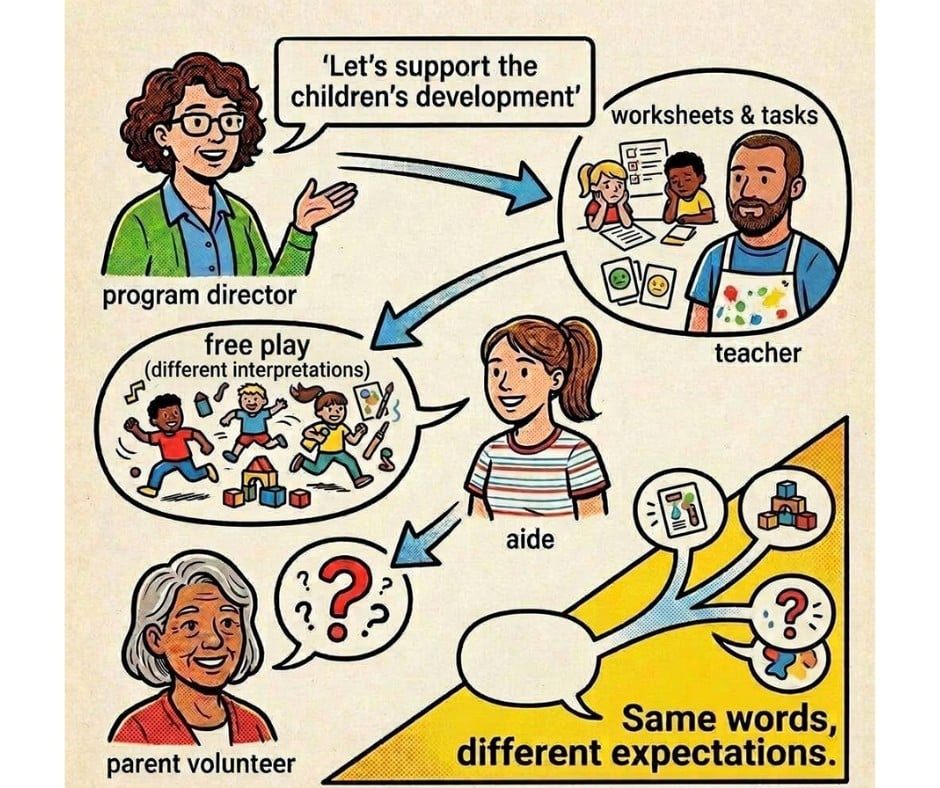
Start with three simple questions:
- What are the most important ideas in our program?
- Are we using the same words to describe them?
- Would every staff member explain them in a similar way?
Clarity is the oxygen of strong early childhood programs.
Without it, even dedicated teams can move in different directions. One teacher may focus on school readiness, another on behavior, and another on supporting families. Everyone is working hard, but not always toward the same goal.
Clarity brings people back together. It strengthens consistency and helps your mission show up in daily practice.
As leaders, it is easy to assume that what is clear to us is clear to others. But words like “quality,” “engagement,” or “professionalism” can mean very different things to different people.
Strong leaders turn big ideas into shared, everyday language.
Instead of saying: “We need better interactions”
Say: “We greet every child by name, get to their level, and respond to their feelings”
Instead of saying: “Be professional”
Say: “We arrive on time, stay engaged with children, and support each other as a team”
Instead of saying: “Focus on family engagement”
Say: “We build relationships with families through daily conversations, not just newsletters”
These small shifts make expectations clear and actionable.
In many programs, the same idea is described in different ways. Words like “lesson plans,” “curriculum,” and “activities” may all be used interchangeably. The same is true for “guidance,” “behavior,” or “assessment.”
It may seem minor, but it creates confusion. Staff spend time interpreting instead of moving forward.
When teams use the same words in the same way, something powerful happens:
- Conversations become clearer
- Expectations become more consistent
- New staff learn faster
- Decisions become easier
Everyone is working from the same map.
Language may feel like a small detail, but it shapes everything.
When language is clear and consistent, people feel more confident, more aligned, and more connected to their purpose.
And that is what strong programs are built on.
Simple Staff Meeting Reflection
Ask your team:
“What is one word we use often that might mean different things to different people?”
Choose one word together and define what it looks like in your program.